For two decades, higher education websites have been optimized for search engines. Today, they’re increasingly being read by AI.
Whether a prospective student asks ChatGPT to compare nursing programs, Claude looks for evening manufacturing certificates, or Gemini explains transfer pathways, AI systems are assembling answers from dozens of sources. The question is no longer whether your institution appears online. It’s which version of your institution AI understands.
That’s what makes llms.txt strategically interesting.
Much of the conversation has focused on the file itself—what it is, who supports it, and whether AI companies use it. Those are worthwhile questions, but they miss the larger opportunity.
A well-crafted llms.txt isn’t just documentation. It can become your institution’s curated narrative for AI.
Think Like a Viewbook, Not a Sitemap
Think about a traditional admissions viewbook.
Every page is intentional. It doesn’t attempt to showcase every office, policy, or archived news story. It tells the story the institution wants prospective students to understand.
A well-crafted llms.txt should serve the same purpose for AI.
Rather than exposing every page, that inaccessible PDF, and forgotten microsite, it can point AI systems toward the content that best explains who your institution is, what it offers, and why it matters.
Done thoughtfully, it becomes a machine-readable viewbook.
Not a marketing brochure, but a curated collection of the pages, documents, and resources you want AI to reference when someone asks almost any question about your college.
Questions like:
- Which community college has the strongest cybersecurity program?
- Can I complete a business degree while working full time?
- Does this college have strong transfer partnerships?
- What support exists for veterans?
- Which college works closely with local employers?
Every answer AI generates is only as good as the information it finds.
A strategic llms.txt helps define what “good information” looks like.
Community Colleges Have the Most to Gain
Community colleges may benefit more from this approach than almost any other sector of higher education.
Most institutions aren’t trying to tell a single story. They’re trying to communicate with recent high school graduates, adult learners, dual-enrollment students, transfer students, veterans, employers, workforce partners, and lifelong learners—all at once.
That complexity often produces sprawling websites filled with duplicate pages, outdated PDFs, disconnected microsites, and inconsistent messaging.
Humans struggle to navigate that environment.
AI does too.
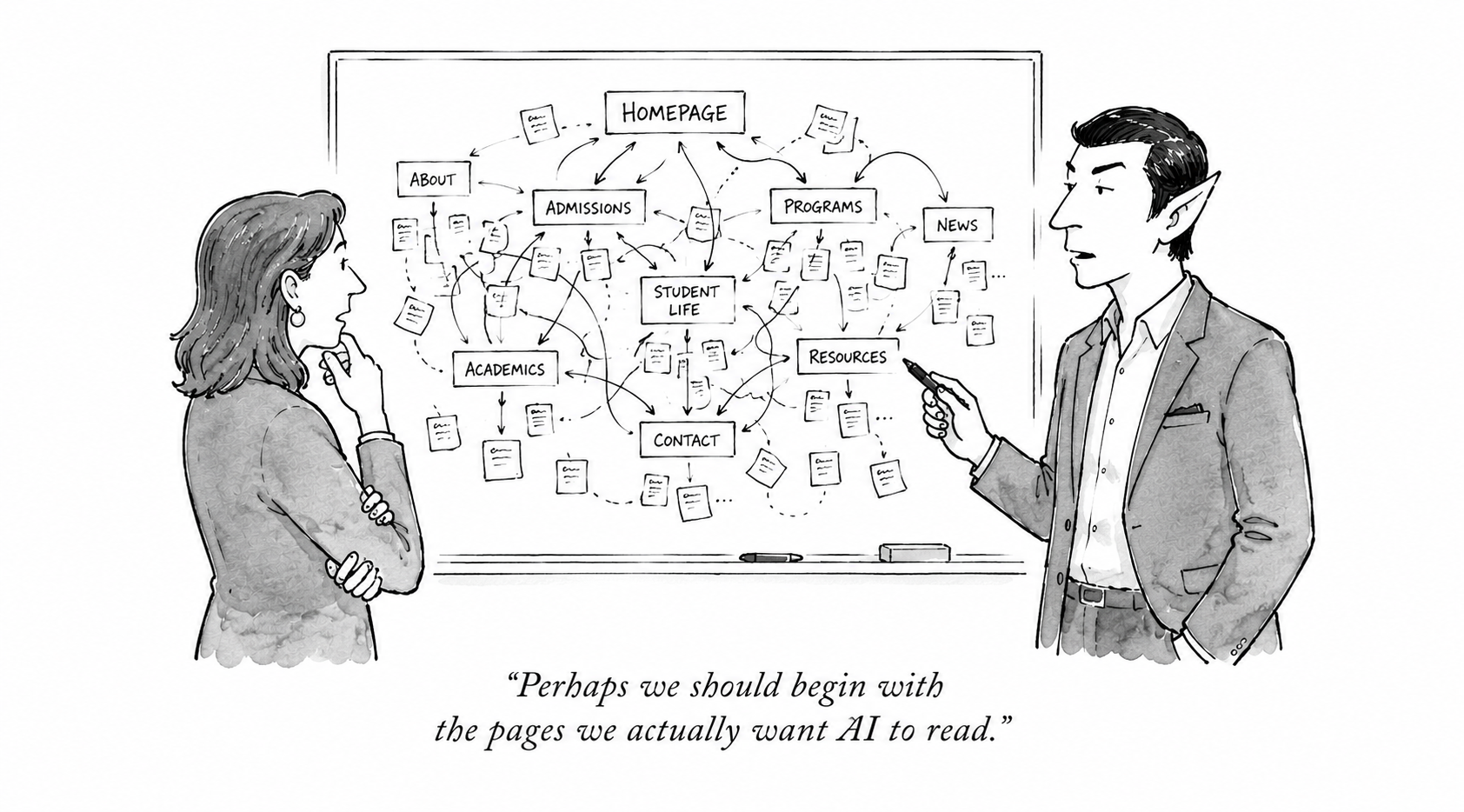
Without guidance, an AI model has to infer your institutional identity from thousands of pages accumulated over years—or decades.
A thoughtfully designed llms.txt offers something deceptively simple:
“Start here. This is who we are.”
The Exercise Matters More Than the File
Ironically, the greatest value of creating an llms.txt may have nothing to do with the file itself.
Building one forces institutions to answer questions they should already know.
Which pages are truly authoritative?
Which program descriptions are outdated?
Why are there three different tuition pages?
Which PDFs should no longer represent the institution?
Who owns this content?
These aren’t technical questions. They’re governance questions. And governance has always been one of higher education marketing’s greatest challenges.
Marketing Should Lead This Conversation
This isn’t simply an IT project.
Nor is it just another SEO exercise.
Marketing teams already steward institutional narrative. llms.txt extends that responsibility into the AI era.
The institutions that perform best won’t necessarily be the ones with the most sophisticated AI tools.
They’ll be the ones that intentionally teach AI who they are.
AI doesn’t browse your website the way people do. It assembles an understanding of your institution from the information you make available.
The question isn’t whether AI will tell your college’s story.
It already is.
The real question is whether you’ve helped it tell the right one.