
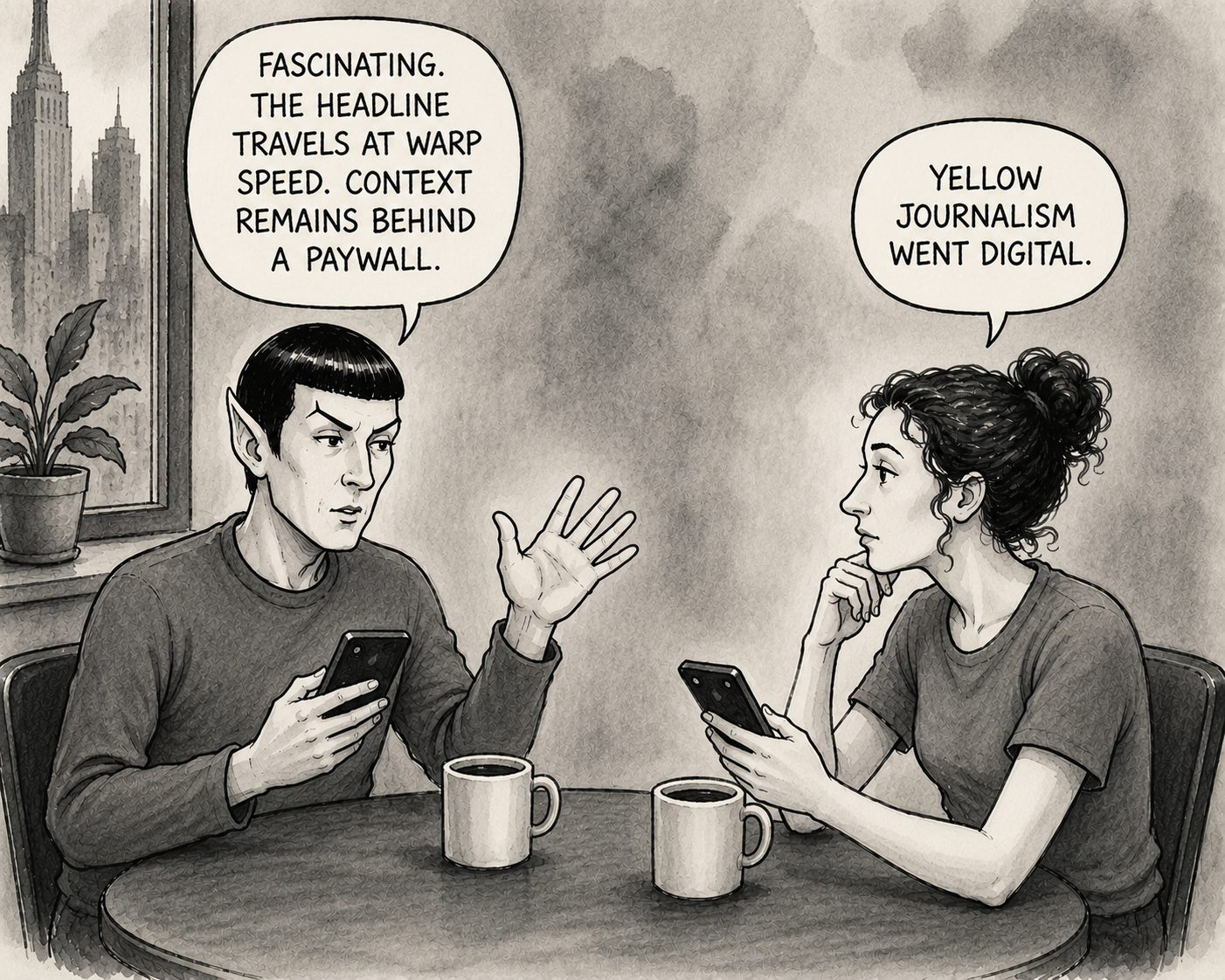
For years we’ve blamed social media for America’s increasingly toxic public discourse. Facebook, X, Instagram, and TikTok have all been cast as villains, accused of amplifying outrage and rewarding division. They’re certainly part of the problem. But they’re only the delivery mechanism.
More than a century ago, newspapers discovered that sensational headlines sold papers. The practice became known as yellow journalism. It prioritized circulation over public understanding, often exaggerating or even fabricating stories to capture readers’ attention.
Yellow journalism didn’t disappear.
It evolved.
Today’s version doesn’t need to invent facts. In many cases, the reporting itself is accurate and well-sourced. The sensationalism has simply moved upstream. The headline is engineered to provoke an emotional response while the reporting that provides the necessary context sits behind a paywall. Millions of people encounter the claim. Far fewer encounter the evidence.
The result is predictable. Most people never read the article. They read the headline, skim a few comments, form an opinion, and jump into the fight. Friends argue with friends. Strangers call each other idiots. Thousands of comments pile up beneath a story that many participants have never actually seen. The publisher has successfully injected another controversy into the public square without ensuring the public has access to the reporting that supposedly justifies it.
That isn’t journalism’s highest calling. It’s yellow journalism, reinvented.
The publisher doesn’t necessarily expect anyone to subscribe. In fact, that’s beside the point. The value lies in dominating the conversation. Every argument keeps the publisher’s name circulating through social feeds. Every share, comment, and angry reaction tells the algorithm that this story deserves even more attention. The article becomes secondary.
The product isn’t the article.
The product is the argument.
This creates a dangerous incentive. The most valuable headline isn’t the most accurate or informative. It’s the one most likely to trigger an emotional response before anyone has time—or, in many cases, the ability—to read the reporting behind it.
Good journalism should reduce uncertainty. It should provide context, challenge assumptions, and help readers understand a complicated world. Yet social media has inverted those incentives. Success is increasingly measured by how effectively a headline starts an argument, not how thoroughly the accompanying reporting informs one.
If a news organization chooses to promote a story in the public square, then the public should have access to that story. Congress should prohibit news organizations from promoting paywalled articles on public social media platforms. If publishers want to sell premium analysis, investigative series, newsletters, documentaries, archives, or subscriber-only features, they should absolutely be free to do so. But if they’re inviting the entire country into a debate, the underlying reporting should not require an admission fee.
Some will argue this infringes on the freedom of the press. It doesn’t. Publishers would remain entirely free to decide what they report, how they report it, and what subscription products they sell. The restriction would apply only to the commercial practice of advertising a story to the public while withholding the very information needed for the public to evaluate it.
We’ve spent years demanding that social media platforms become more responsible because they amplify outrage. It’s time to ask whether news organizations deserve similar scrutiny when they deliberately manufacture it.
Journalism informs democracy only when citizens have access to the information they’re being asked to debate. If publishers choose instead to monetize the argument while restricting access to the article, they’ve stopped selling journalism.
They’re selling conflict.
And that’s a business model America can no longer afford.