
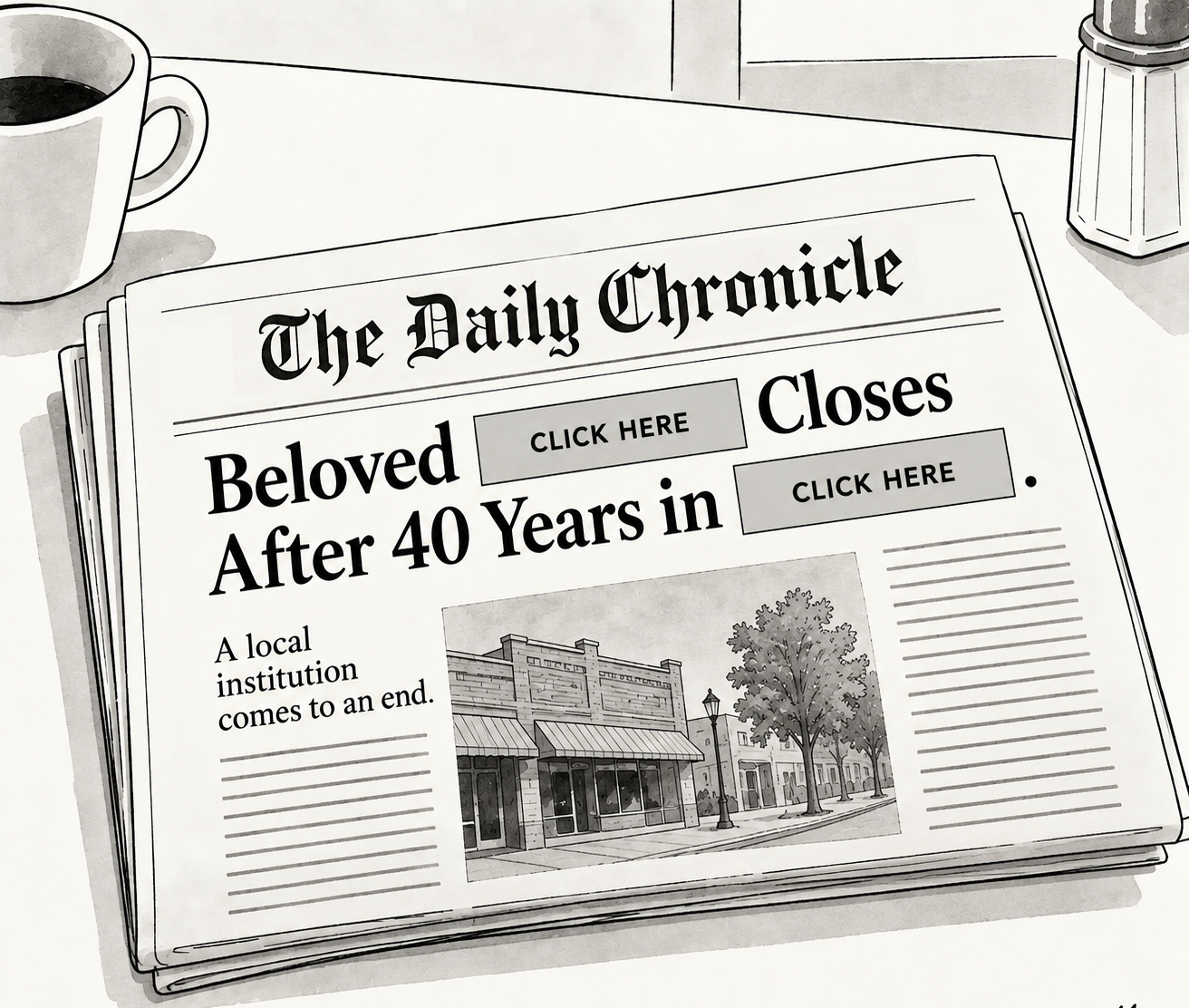
There’s a new public service being performed every day in the comments beneath local news stories on Facebook.
A news outlet posts that a popular restaurant has suddenly closed after decades in business. Or that a major employer is laying off hundreds of workers. Or that something terrible, strange or noteworthy happened in “a Massachusetts community.”
Within minutes, somebody in the comments supplies the piece of information conspicuously absent from the post: “It’s Worcester.” “The company is CVS.” “It’s the restaurant on Main Street.” Sometimes they even add the increasingly familiar: “Saved you a click.”
Thank God for these people.
News organizations have apparently rediscovered vaguebooking, that irritating social media habit in which someone posts “I guess I know who my real friends are…” and waits for everyone to ask what happened. Only now it has been professionalized. The missing information isn’t withheld because an aggrieved cousin wants attention. It’s withheld because a media company wants a click.
There’s an obvious economic reason for that. The story lives on the publisher’s website, not Facebook, and publishers need readers to leave one and visit the other. Traffic matters. Advertising impressions matter. Subscriptions matter. Journalism costs money, and after watching the economic foundation of their industry disintegrate over the past two decades, news organizations have every reason to care deeply about how people get from a Facebook feed to their journalism.
But somewhere along the way, the social post stopped being a useful presentation of the news and became an advertisement for information the publisher already has.
That’s an odd development for a profession built around telling people the important stuff first.
The old newspaper lede was supposed to answer some combination of who, what, when, where, why, and how. The social media tease has discovered that one of those answers can be considerably more valuable if you leave it out.
“A longtime Massachusetts business is closing after more than 50 years.”
Which business?
“A New England company plans to eliminate hundreds of jobs.”
Which company?
“A popular restaurant is opening its first location in a Central Massachusetts community.”
Where?
There’s nothing inherently wrong with expecting someone to click if they want the full story. A headline and social post cannot, and shouldn’t, contain every piece of reporting. The problem comes when the publisher deliberately removes the one basic fact that would allow the reader to decide whether the story is relevant in the first place.
And then there’s the paywall.
You click because you want to know which town. Instead, you discover that you’ve reached your monthly article limit and need a subscription to continue. You weren’t persuaded to click because the reporting sounded so valuable that you wanted to read it. You were persuaded to click because the publisher withheld a noun.
Those are very different transactions.
This isn’t an argument against paying for journalism. Quite the opposite. Good reporting is expensive, and pretending otherwise helped create the economic mess news organizations are now trying to escape. But publishers themselves have demonstrated that there are different ways to make that economic relationship work.
The New York Times has built an extraordinarily successful digital subscription business around the proposition that its journalism is worth paying for. The Guardian has taken a different approach, keeping its journalism broadly accessible while asking readers who value it to financially support the organization. One restricts access as part of its subscription model; the other largely puts the request for money around the journalism rather than in front of it.
Both models recognize the same basic truth: journalism has value and somebody has to pay for it.
Publishers have also recognized that the paywall creates a problem when readers themselves want to share journalism. The Times is one of many that gives subscribers a way around it through “gift articles”: special links subscribers can share that allow someone else to read an otherwise restricted article without encountering the usual paywall.
Think about what that feature acknowledges. A subscriber finds something interesting and says, essentially, “You should read this.” The publisher understands that answering that invitation with “Subscribe first” can stop the interaction cold, so it allows its paying customer to open the door for someone else.
That’s smart. The journalism gets read. The subscriber gets additional value from the subscription. And a potential future subscriber gets to experience the product before being asked to buy it.
Which makes the vaguebooking approach feel even more backward.
If publishers understand the value of removing the paywall when one reader recommends a story to another, why manufacture unnecessary friction before the reader has even decided whether the story is worth reading?
The paywall isn’t the problem. The ambush is.
If you tell me that XYZ Corp. is closing its Worcester factory and eliminating 300 jobs, I now know what happened. If I want to understand why it’s closing, what happens to those workers, what the company says, what local officials are doing and what this means for Worcester, that’s journalism.
You have something valuable to sell me.
But if you tell me only that “a major Massachusetts employer is closing a longtime facility,” you’ve manufactured a different transaction. Now I’m not clicking because you’ve convinced me that your reporting has value. I’m clicking because you deliberately withheld Worcester.
And if the next thing I see is a subscription offer before I can even discover that the town is Worcester, you haven’t demonstrated the value of your journalism. You’ve demonstrated your ability to get me to visit a checkout page.
Readers seem to understand the difference instinctively, because they have begun building their own workaround.
Someone clicks. Maybe that person is already a subscriber. Maybe they have free articles remaining. Maybe they navigate the pop-ups and prompts and eventually get to the story. Whatever the path, they find the missing information, return to Facebook and put it in the comments.
Then everyone else starts liking that comment.
What’s fascinating about this behavior is that readers aren’t simply complaining about clickbait anymore. They are collectively correcting it. The comment section has become a crowdsourced utility layer sitting between the publisher and its audience, restoring the information the publisher intentionally removed.
In a strange way, the commenter is practicing an older form of journalism than the news organization is.
Here is the important thing. Here is where it happened. Here is who it involves. Now decide whether you care enough to know more.
That last part is important, because publishers should want people to care enough to know more. A person genuinely interested in a story is worth far more than a person irritated into clicking it. One is a potential reader, subscriber, supporter or loyal customer. The other is a metric.
There’s a broader lesson here for anyone who markets anything online. Optimization has a nasty habit of making us very good at producing the behavior we can measure while slowly damaging things that are harder to see. If withholding the town produces more clicks, the dashboard tells us the strategy worked. It doesn’t tell us how many people rolled their eyes, hit the back button, complained about the paywall, or learned that next time they can simply check the comments.
That’s the danger of confusing a conversion with a relationship.
Every time a publisher makes its own social content deliberately less useful to generate another click, it teaches its audience something about the brand. Do it often enough and the audience adapts. People stop assuming the news organization is trying to inform them in the feed and start assuming it is trying to manipulate them out of it.
And then something wonderfully predictable happens.
The publisher says, “A Massachusetts town…”
And some stranger in the comments says, “Worcester.”
Hundreds of people give the stranger a thumbs-up.
The news organization got its engagement.
Just probably not the kind it was hoping for.