
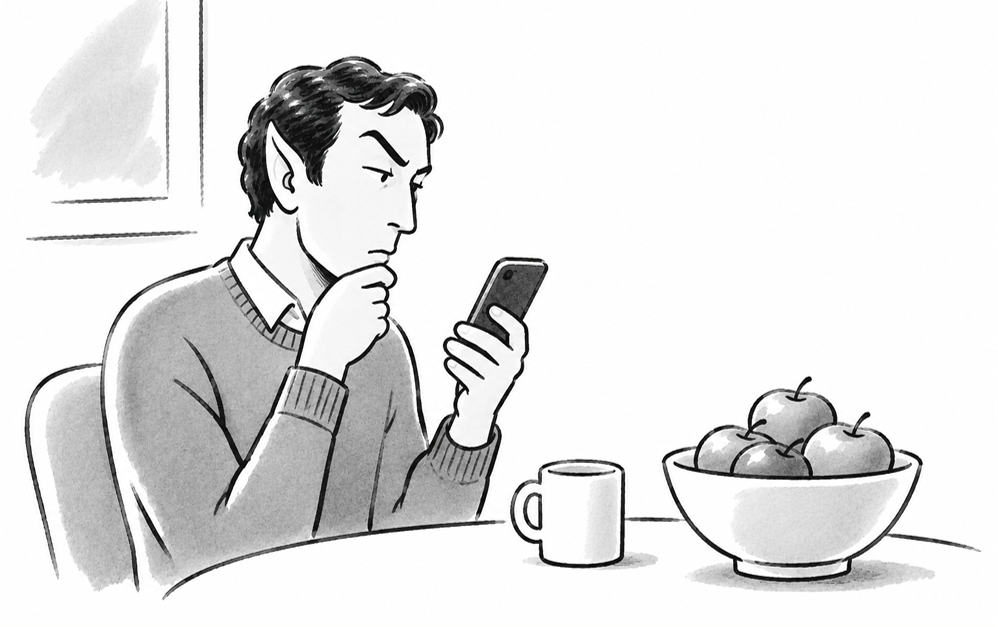
I’ve noticed something on Threads that I find both entertaining and revealing: sometimes the audience takes a conversation somewhere its author never intended.
It’s particularly satisfying when the target is an obvious bot account or someone making sweeping assertions about a subject they clearly don’t understand. A provocative claim appears, presumably intended to generate agreement, outrage, or simply attention. Instead, someone responds with something utterly unrelated, and that response attracts exponentially more likes than the original post.
Consider someone complaining that Star Trek needs to return to its supposedly pre-woke roots. Rather than debate a peculiar interpretation of a franchise built around social commentary, someone replies with a photograph of a bowl of apples.
The apples get thousands of likes. The original post gets a handful.
It’s called getting ratioed: when a reply attracts more likes than the original post, sometimes by an astonishing margin. In this case, nobody even bothers to debate the original assertion.
I’ve written before about news outlets engaging in vaguebooking, deliberately withholding essential information from social media posts to encourage clicks. A newspaper teases a restaurant closing or some supposedly remarkable local development without mentioning the one detail readers actually want to know. Within minutes, someone supplies the missing information in the comments, neatly defeating the strategy.
I’ve started to wonder whether these two phenomena have something more interesting in common.
Perhaps we’re witnessing the emergence of a new kind of media literacy.
Recognizing Engagement Bait
Traditional media literacy focuses on evaluating information. Is the source credible? Is the reporting accurate? What biases might influence the message?
But there’s another question worth asking: what is this content trying to get me to do?
The reader who supplies a restaurant’s name beneath a vaguebooking post isn’t challenging the reporting. They’re challenging the publisher’s decision to withhold information for the sake of traffic.
Getting ratioed can reflect a similar instinct.
Threads is littered with dubious historical claims, questionable scientific observations, and inflammatory pronouncements seemingly designed to provoke arguments. Some come from genuinely misinformed people. Others appear to be engagement farms, increasingly assisted by AI.
And I suspect some know perfectly well that what they’re posting is nonsense.
After all, being wrong can be productive. People feel compelled to correct misinformation or challenge absurd assertions, generating precisely the activity the account was seeking.
But recognizing the engagement bait creates another option: refusing to take it seriously.
Tactical Media Literacy
I’ve been thinking of this as tactical media literacy.
Where traditional media literacy evaluates the message, tactical media literacy recognizes the strategy behind it.
Why am I being shown this? What does the publisher want me to do? And why should I cooperate?
It’s a useful distinction because manipulation doesn’t necessarily require misinformation. A news outlet can publish an entirely accurate story while withholding its most useful detail from a social media post. Engagement farming can provoke an argument without caring whether anyone believes the original claim.
The audience, meanwhile, can choose to respond on its own terms.
Supply the missing information. Decline to debate an obvious provocation. Or collectively reward a photograph of fruit that has absolutely nothing to do with the subject.
I’m not suggesting every such response represents a conscious act of resistance. Sometimes a joke is simply a joke. Nor would I claim these examples establish some sweeping change in audience behavior.
But I do think they offer clues about how people are adapting to an increasingly manipulative media environment. Recognizing questionable content is one thing. Recognizing the methods used to attract attention, and occasionally finding ways to subvert them, suggests something more.
Reach Isn’t Influence
For those of us in marketing, this raises an interesting question about the difference between reaching an audience and influencing one.
We’ve spent years refining techniques to extend our reach. We test headlines, optimize messages, segment audiences, and measure results with extraordinary precision.
But reach measures exposure. Influence concerns what people take away from that exposure: whether they accept a message, trust its source, reconsider an opinion, or change their behavior.
And recognizing a publisher’s tactics can fundamentally affect that outcome.
Our Star Trek enthusiast may achieve considerable reach. But when thousands of people endorse an utterly irrelevant reply, the audience is making a judgment about the original post without bothering to engage with its argument.
The message reached them. That doesn’t mean it earned their consideration.
A news outlet faces a quieter version of the same problem. Vaguebooking may generate traffic while reinforcing the perception that the publisher values clicks more than readers.
Neither outcome is necessarily reflected in a conventional social media performance report.
Which raises a question worth considering: if an audience recognizes our attempt to influence its behavior and responds by rejecting the tactic, what exactly have we accomplished?
A More Discerning Audience
I find the possibility of this emerging literacy encouraging, even if its expressions aren’t always especially sophisticated.
It doesn’t mean audiences have become immune to manipulation. The continued success of clickbait and engagement farming suggests otherwise. But these examples hint at a more critical relationship with the content competing for our attention.
And that presents an interesting challenge for publishers and marketers.
We’ve invested heavily in understanding audiences: what they know, what they believe, what interests them, and what might prompt them to act.
Perhaps we haven’t given enough consideration to how well audiences have come to understand us.
A familiar tactic eventually becomes predictable. Manufactured curiosity can become irritating. And an attempt to provoke outrage can become little more than the setup for someone else’s joke.
Perhaps the next evolution of media literacy involves not just deciding whether to believe what we’re seeing, but understanding why we’re being shown it in the first place.
After all, publishers and marketers have spent decades studying how to capture attention.
It seems audiences have been studying us right back.
How ’bout them apples?