
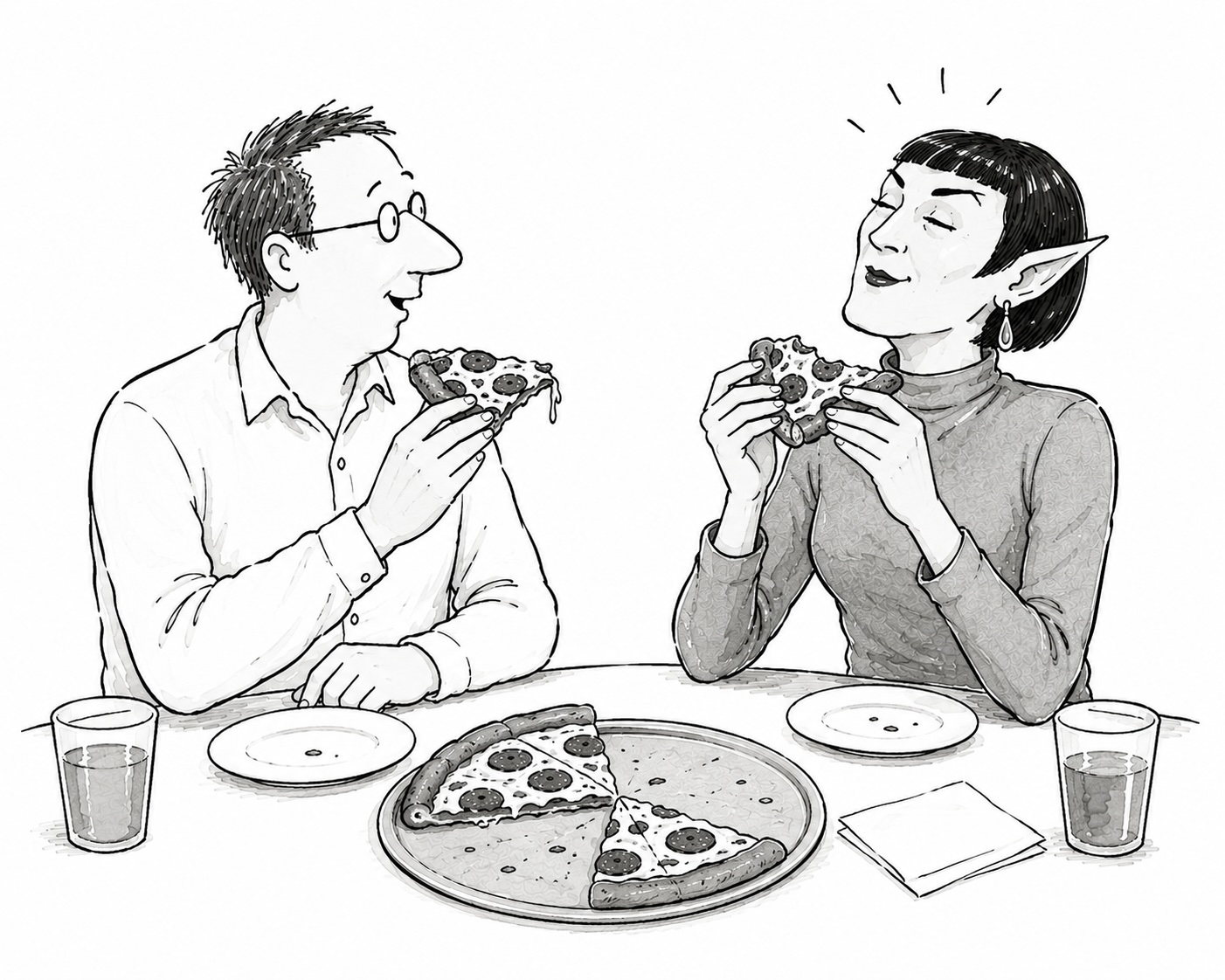
It’s one of those statements that draws a reaction without anyone stopping to wonder why.
Objectively, pizza isn’t built from extraordinary ingredients. Nothing in a pizza should produce the kind of loyalty the food enjoys around the world.
Yet it does.
That tells us something important—not just about pizza, but about how people assign value.
We say it because pizza is greater than the sum of its parts.
On their own, the ingredients are unremarkable. Dough is little more than flour, water, salt, and yeast. Tomato sauce is ordinary. Cheese is common. Most toppings are foods we’d rarely crave by themselves.
None of those components explains why pizza has become one of the world’s most beloved meals.
Psychologists and food scientists have long understood that pizza succeeds because it delivers several forms of satisfaction at once. Fat, salt, carbohydrates, acidity, aroma, texture, and temperature combine into an experience that stimulates multiple reward systems simultaneously. No single ingredient creates the magic. It emerges from the interaction among them.
Pizza also benefits from context. Few foods are as closely associated with shared experiences. We eat it at birthday parties, after Little League games, during movie nights, at office celebrations, and around college dorm tables. It arrives in the middle of conversations, celebrations, and late-night debates. Over time, those memories become inseparable from the product itself.
The value of pizza, then, isn’t simply what’s in the pie. It’s the combination of ingredients, the experience they create, and the moments they help make possible.
Organizations often make the opposite assumption about marketing.
They search for the one thing that will set them apart: a better tagline, a redesigned website, a viral campaign, a new logo, a product launch, or the latest AI initiative.
Those things matter.
None carries the brand by itself.
A strong brand is an integrated system. Product quality, customer experience, leadership communication, pricing, visual identity, employee behavior, sales conversations, service recovery, social proof, word of mouth, and organizational culture all contribute to the same perception. Every interaction either reinforces or weakens what people believe about the organization.
The mistake is treating these elements as independent initiatives instead of interconnected signals.
An organization with exceptional customer service can undermine itself with confusing messaging. A beautifully designed website cannot compensate for inconsistent leadership. An award-winning advertising campaign cannot overcome a disappointing product experience. Likewise, an exceptional product can struggle if the surrounding experience fails to inspire confidence or create meaningful connections.
This is why marketing should be viewed less as promotion and more as orchestration.
The marketer’s job is not simply to produce communications. It is to help ensure that the organization’s many signals point in the same direction. When they do, customers experience something that feels coherent, trustworthy, and intentional. When they don’t, every investment produces less value than it should.
No one falls in love with pizza because of the flour.
They fall in love with the complete experience—the ingredients working together, the anticipation of opening the box, the conversation around the table, and the memories created slice by slice.
Great brands work the same way.
Competitive advantage rarely comes from one brilliant campaign or one remarkable touchpoint. It emerges when products, people, experiences, and stories consistently reinforce one another.
Like any pizza, the whole becomes more valuable than the sum of its parts.