
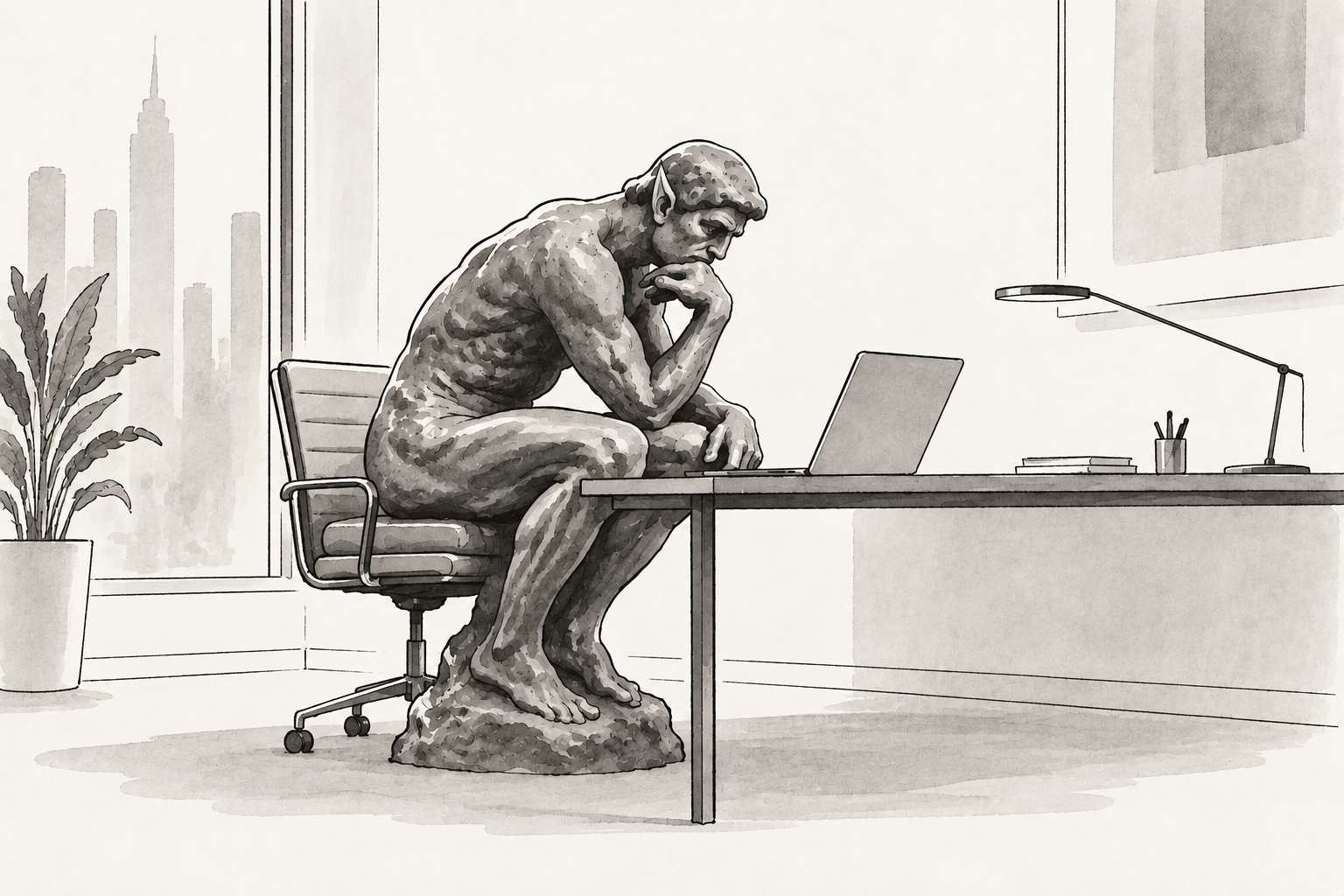
A research administrator at the University of Kentucky recently received an unusual workplace accommodation: permission to do his job without using artificial intelligence.
David Durman, a humanist, argued that AI conflicted with his deeply held beliefs about independent thinking, human creativity, and moral responsibility. His employer agreed to grant him a religious accommodation from using AI.
Humanism places reason, compassion, and human dignity at the center of ethical decision-making. It holds that we have both the ability and responsibility to think critically, exercise judgment, and consider how our actions affect others.
Durman’s objection isn’t simply a rejection of technology. It’s a defense of human agency. The American Humanist Association, which helped secure his accommodation, considers the decision a first for a self-avowed humanist.
I don’t necessarily share his conclusion. I use AI myself, sometimes with impressive results. But I find the philosophy behind his objection compelling, particularly when applied to marketing.
Capability isn’t competence
Marketing has benefited enormously from technology. Research, analytics, automation, and increasingly sophisticated communications platforms have expanded what we can accomplish, often with fewer resources.
AI takes that further. It can accelerate research, analyze information, explore alternatives, and produce work that once required considerable time and effort.
But access to sophisticated tools doesn’t confer expertise.
Someone with an analytics platform doesn’t automatically understand research. Someone operating marketing automation software doesn’t necessarily understand audiences. And someone generating a campaign strategy with AI doesn’t necessarily know whether that strategy makes sense.
AI can produce work that appears thoughtful, comprehensive, and professionally informed. Sometimes it is. Sometimes it’s fundamentally misguided.
There’s a particular polish to AI-generated work that can make even mediocre output appear impressive. Confident language, orderly structure, and just enough jargon to suggest expertise. To an untrained eye, even AI slop can look remarkably accomplished.
Seasoned marketers can often spot it a mile away. Generic observations masquerading as insights. Predictable phrasing. Recommendations that sound reasonable until someone asks what they’re actually based on.
The problem isn’t necessarily the technology. It’s whether the people evaluating its output know enough to recognize what’s missing.
The judgment business
Consider a familiar assignment: develop a campaign to increase enrollment, boost sales, or strengthen awareness.
AI can generate personas, positioning statements, messaging recommendations, and communications plans. With the right direction, some of that work can be quite good.
But experienced marketers contribute something beyond assembling those pieces.
We question assumptions, distinguish communications problems from product problems, and recognize organizational realities that don’t fit neatly into strategic frameworks.
Design thinking, for example, begins with understanding people’s experiences and needs before proposing solutions. AI can generate a convincing customer persona, but that’s not the same as understanding an actual customer.
Semiotics adds another layer. Marketing depends on language, imagery, symbols, and cultural associations. What we intend to communicate isn’t necessarily what audiences understand. Meaning is shaped by experience, context, and interpretation.
AI can recognize patterns in language and imagery. That doesn’t guarantee an understanding of why a message resonates, falls flat, or means something entirely different to its audience.
Then there’s the special sauce that distinguishes the best marketers: an instinctive understanding of popular culture and the zeitgeist. Being culturally-aware means more than knowing what’s trending. It means understanding why something matters at a particular moment, how cultural references carry different meanings, and when a brand has something relevant to contribute.
The best marketers don’t merely follow culture. They recognize its undercurrents, connect seemingly unrelated ideas, and occasionally anticipate where it’s headed. That sensibility comes from curiosity, lived experience, and a willingness to look beyond marketing itself.
AI can identify trends and reproduce cultural references. But recognizing the zeitgeist isn’t the same as understanding it, and borrowing from pop culture isn’t the same as contributing something meaningful to it.
Sometimes the most valuable marketing recommendation is to reconsider the campaign altogether.
That’s where Durman’s humanist perspective resonates. Independent reasoning and personal accountability aren’t obstacles to innovation. They’re what help us determine whether innovation serves a worthwhile purpose.
And when producing plausible recommendations becomes almost effortless, knowing which ones are worth pursuing becomes considerably more valuable.
The creative contradiction
There’s another aspect of AI adoption that marketing professionals should find uncomfortable.
Generative AI learns from enormous collections of human-created material: writing, photography, illustration, music, design, and other intellectual work. Some of that material has been used for training without its creators’ explicit permission or compensation.
Consider Anthropic, the company behind Claude. Through an initiative called Project Panama, it purchased and destructively scanned millions of physical books, removing their bindings, digitizing their pages, and destroying or recycling the originals.
Its acquisitions included obscure academic works and less-common titles, some potentially out of print. Although Anthropic maintains that it did not purchase rare or antiquarian books for destruction, the scale of the operation raises legitimate questions about the loss of scarce, difficult-to-replace copies. A Stanford Humanities Center examination of destructive book scanning explores that concern and the distinction between rare, antiquarian, and out-of-print works.
Think about that. To teach machines to write, we’re destroying the physical products of human writing.
Contrast that with Google Books’ efforts to digitize and make published works discoverable and the Internet Archive’s Open Library initiative, which connects readers with digitized books for discovery, reading, and borrowing.
Even the Vatican Apostolic Library is digitizing centuries-old manuscripts, opening collections once largely reserved for scholars able to visit Rome.
All are using sophisticated technology to process human knowledge. But there’s an important distinction between preserving that knowledge for future generations and extracting it to develop proprietary commercial products.
The legal questions surrounding AI training remain contested. The ethical ones deserve just as much attention.
Marketing depends on creative professionals whose work gives our discipline much of its value. Yet we’re enthusiastically adopting technologies trained on enormous quantities of existing creative material, often without meaningful consideration of the people who produced it.
Artists have always learned from other artists. Creativity doesn’t occur in isolation. But there’s a difference between inspiration and industrial-scale ingestion.
What happens to creative professions when the economic value of original work diminishes while demand for automated alternatives grows?
Humanism asks us to consider not just what technology makes possible, but who benefits, who bears the costs, and what we might lose along the way.
What are we rewarding?
Marketing has always had a visibility problem.
Everyone sees the campaign, website, advertisement, or social post. Far fewer see the research, creative exploration, strategic decisions, and occasional difficult conversations behind them.
And because everyone encounters marketing, an awful lot of people assume they’re qualified to practice it.
AI may reinforce that misconception. If anyone can generate a professional-looking marketing plan, the distinction between producing the document and possessing the expertise behind it becomes less obvious.
Organizations can easily count AI licenses, measure production volume, and celebrate time saved. Evaluating professional judgment is harder.
Was the right problem identified? Were the assumptions sound? Did the recommendations reflect actual audience behavior? Was the work original, relevant, and effective?
And did the process respect the people whose creative contributions made it possible?
These questions matter regardless of whether AI was involved.
The risk isn’t that artificial intelligence will eliminate the need for professional judgment. It’s that organizations may increasingly reward the appearance of technological sophistication over the exercise of that judgment.
Keeping the human in humanism
I suspect David Durman and I would disagree about how extensively AI should be used in professional life.
I see enormous potential in technology that extends human capabilities. Using AI doesn’t necessarily mean surrendering independent thought or creative responsibility.
But his objection deserves more than a passing mention as an unusual religious accommodation.
It’s a reminder that technological progress and human progress aren’t necessarily the same thing.
For marketing, that distinction matters. Our profession depends on understanding people, interpreting meaning, exercising judgment, and creating work that connects with human experience.
AI can help us do those things. It can also make it easier to imitate them.
The challenge isn’t simply determining how much of marketing AI can perform.
It’s remembering what makes the work valuable in the first place.
Progress isn’t just about what technology allows us to do. It’s about what we choose to do with it, and what those choices mean for the people involved.