
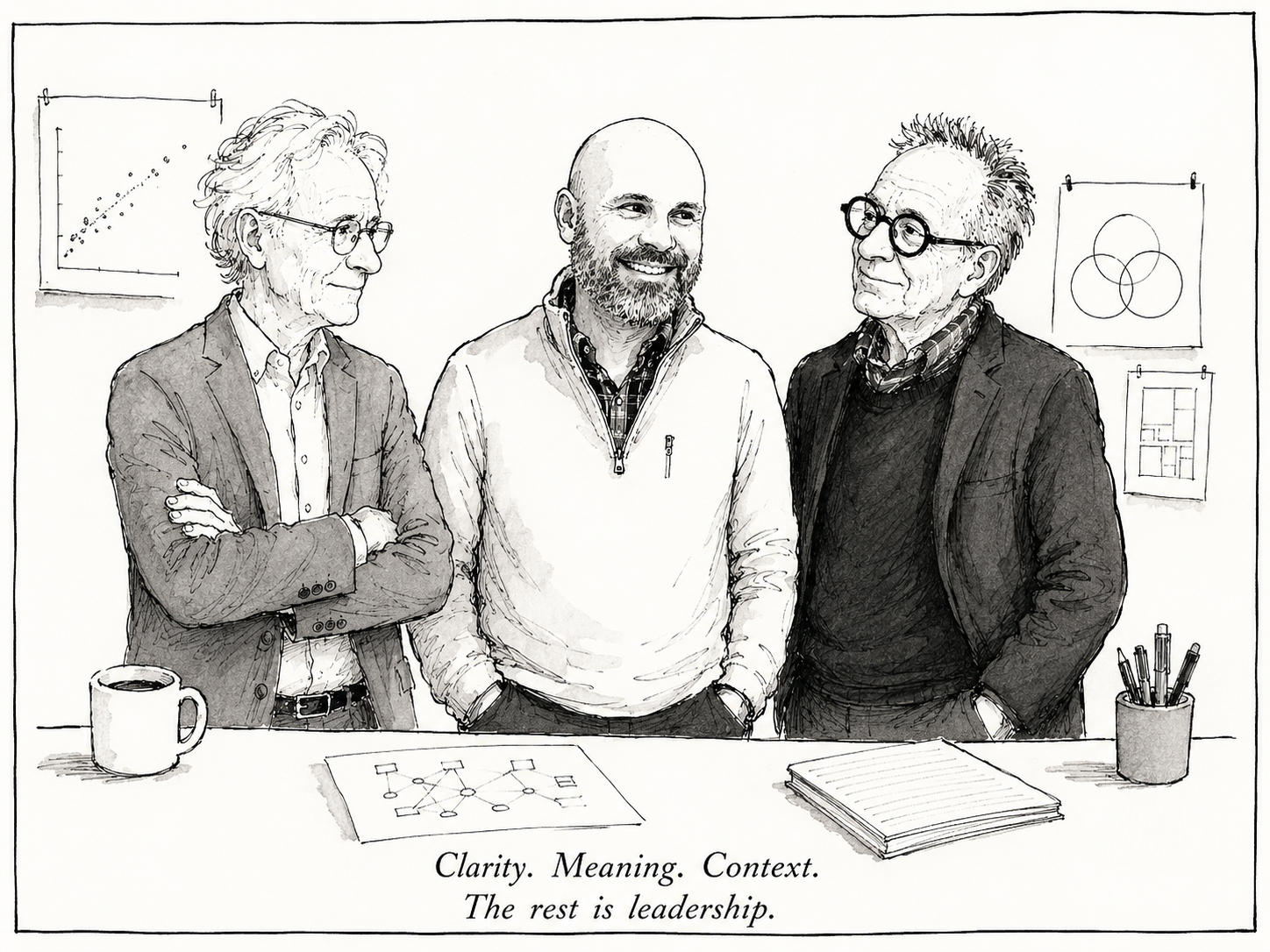
Twenty years ago, I spent a week studying with Edward Tufte. Around the same time, I had the opportunity to learn from Thomas Ockerse at the Rhode Island School of Design (RISD). On paper, they could not have been more different.
Tufte is widely known for his work on information design, data visualization, and analytical thinking. Ockerse was a pioneering design educator whose work explored systems, semiotics, and the deeper structures of communication and meaning.
Yet looking back across my career, I realize both men taught me the same lesson.
Learn to see what others miss.
Tufte taught me that information should reveal truth, not obscure it. Good communication is not about decoration. It is about clarity. Data, properly organized, tells a story. Poorly organized, it creates confusion, bias, and bad decisions.
His work encouraged me to ask simple but powerful questions. What is the evidence? What is the signal? What is the noise? What are we actually trying to communicate?
Those questions followed me into marketing, communications, enrollment strategy, and executive leadership. Whether evaluating campaign performance, labor market data, enrollment trends, or organizational culture, I learned to look beyond anecdotes and assumptions and focus on what the information was actually saying.
Ockerse approached communication from a different direction. He challenged students to think about meaning itself. Every symbol, every design choice, every interaction sends a signal. Communication is not merely what we say. It is what people understand.
His influence can be found throughout my career as well. Organizations often focus on messaging while overlooking meaning. They obsess over logos, websites, campaigns, and taglines while ignoring the signals embedded in culture, behavior, leadership, and decision-making.
The lesson I carried forward was that people rarely respond to what organizations intend to communicate. They respond to what organizations actually communicate through their actions.
Over time, these two perspectives merged.
From Tufte, I learned to seek clarity.
From Ockerse, I learned to seek meaning.
Looking back, I can also see how these experiences connected to my formal education. My bachelor’s in sociology taught me to look beyond individuals and understand the systems, institutions, and relationships that shape behavior. Decades later, my master’s studies in management deepened that perspective through the lenses of leadership, value chains, and organizational performance. Together, they reinforced a belief that outcomes rarely emerge from isolated actions. They are the product of interconnected systems, incentives, relationships, and meaning.
Together, they shaped how I approach leadership, communications, and organizational strategy. They taught me to see organizations as systems. Data becomes more meaningful when viewed in context. Narratives become more powerful when grounded in evidence. Strategy becomes more effective when it acknowledges both what people think and how they interpret the signals around them.
When I advise leaders today, I often find myself doing some version of the same work. I help organizations understand what their data is saying. I help them understand what their stakeholders are hearing. Most importantly, I help them identify the gap between the two.
That gap is where many organizational challenges live.
It is also where many opportunities live.
The technologies, industries, and institutions I have worked with over the last two decades have changed dramatically. The lessons from those classrooms have not.
Look for the signal.
Look for the meaning.
Learn to see what others miss.