

There is a peculiar ritual in higher education that usually happens toward the end of a grant reporting period. Someone discovers there is money left in the grant budget, an expiration date is approaching, and suddenly marketing gets a phone call asking how quickly we can spend it.
Of course we can spend it. Spending money has never been the difficult part.
The more useful question is whether spending it now will accomplish anything.
I had seen this movie enough times before arriving at Northern Essex Community College. A grant proposal would include money for marketing because outreach was necessary to achieve whatever enrollment, participation, or awareness goals the grant was intended to support. Marketing, however, often wasn’t involved when those goals were established, the strategy was developed, or the budget was built. Months later, the remaining money would arrive with an urgent request to use it before the reporting period ended.
This is how organizations end up buying digital ads because digital ads can be purchased quickly, ordering promotional items because somebody can get 500 of them here by Thursday, or discovering an urgent institutional need for enough branded tote bags to equip a small infantry division.
None of those things is inherently useless. I’ve bought ads. I’ve bought swag. Some of it has even been pretty good swag.
The problem is starting with the money and asking what marketing can buy instead of starting with the objective and asking what marketing should do.
In 2024, I approached the grants team at NECC with a simple proposition: bring marketing into the process while grant proposals are being developed.
Thankfully, they were receptive. This wasn’t marketing trying to annex another piece of the institution. The grants team understood the logic immediately. If a proposal anticipates needing marketing to produce an outcome, perhaps the people responsible for marketing should have some role in determining what that work entails, what it costs, when it needs to happen, and what else needs to be in place for it to work.
Revolutionary stuff, I know.
We got an opportunity to put the idea into practice with NECC’s growing competency-based education offerings.
Competency-based education, or CBE, is particularly well suited to many of the students community colleges serve. Rather than making time spent in a classroom the organizing principle, CBE allows students to progress by demonstrating mastery of defined competencies. For working adults, career changers, and people bringing years of professional and life experience back to college, that can materially change the proposition.
NECC had been building its CBE capacity for years, so the marketing challenge wasn’t to manufacture a reason for people to care about it. We had something genuinely different to put in front of prospective students. The challenge was making sure we could get the right people interested in it and then make it ridiculously easy for them to do something about that interest.
With grant resources planned for that purpose, we launched a full advertising blitz around NECC’s expanding CBE catalog. At the center of the creative was an explainer video designed to make a somewhat wonky academic concept immediately understandable, complete with a voiceover that might or might not have been Brené Brown. Around that, we could build the audience, message, media, timing, and destination as parts of the same effort instead of trying to vaporize a remaining budget before a reporting deadline.
That last one turned out to matter quite a bit.
Higher education has a remarkable talent for spending money persuading people that something is simple and then sending them to a website determined to prove otherwise.
We could advertise the flexibility of CBE all day long, but if someone responded to the campaign and landed in a conventional course-search tool, we were asking that person to figure out how our institution organized the thing we’d just persuaded them to explore. Find the right subject. Choose the right filters. Decode the course sections. Maybe consult an academic calendar. Perhaps sacrifice a goat.
That’s not a marketing funnel. That’s an obstacle course.
So we worked internally to create a one-click CBE option in the course-search tool. Someone interested in competency-based courses could click once and see them.
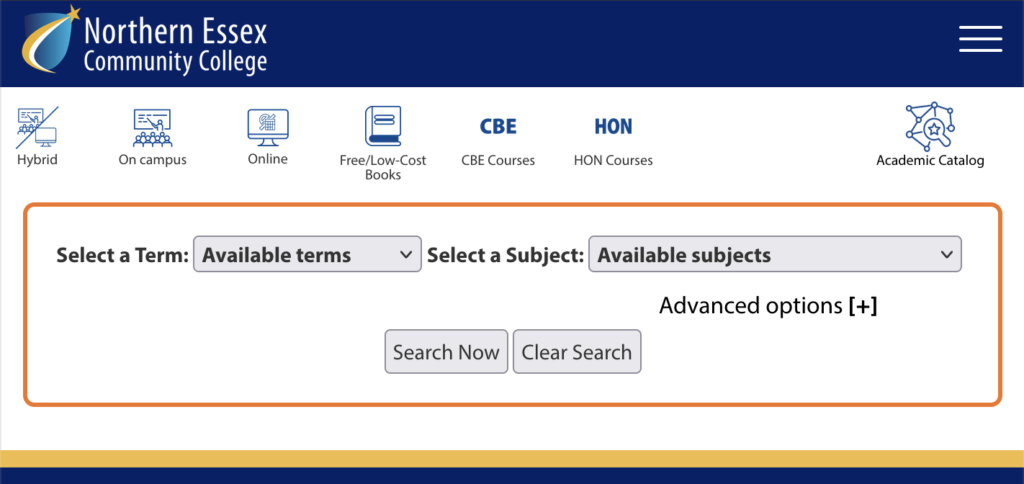
It wasn’t a monumental technology project. That was precisely the point. Sometimes the barrier between institutional strategy and a prospective student’s ability to act on it is not a multimillion-dollar CRM implementation. Sometimes it’s a button nobody thought to create because everyone was looking at their individual piece of the process.
The advertising people were thinking about advertising. The academic people were thinking about courses. The technology people were thinking about the course-search tool. The grants people were thinking about the grant.
The prospective student, inconveniently, experiences all of it as one thing.
That’s where I think higher education often misunderstands marketing’s role. Marketing doesn’t stop at the edge of an advertisement, a website, or a communications plan. If we’re spending money to generate interest in something, we should care deeply about what happens to that interest after somebody responds.
A beautifully targeted campaign that sends people into a lousy experience isn’t a successful campaign with somebody else’s problem attached to it. It’s a lousy experience we paid to send more people into.
And that’s why bringing marketing into grant development matters.
Marketing people know what media costs, how long campaigns take to develop, what creative production requires, and how much lead time is necessary to test, learn, and adjust. More importantly, a good marketing operation understands that communications spending cannot compensate for friction elsewhere in the customer journey. Put that knowledge into the proposal stage, and the marketing budget becomes part of the strategy for achieving the grant’s objectives. Leave marketing out until the end, and that same budget can become a frantic exercise in finding allowable expenses before the fiscal clock hits zero.
Colleges love talking about breaking down silos. We put it in strategic plans, devote retreats to it, and occasionally form committees composed of representatives from each silo to discuss how siloed we are.
A better test is much simpler: when do you invite people into the work?
If marketing is expected to help produce enrollment, participation, or awareness, bringing the team in after the program has been designed, the grant approved, the budget allocated, and the clock started isn’t collaboration. It’s fulfillment.
The same is true of IT, institutional research, student affairs, and plenty of other functions colleges routinely treat as downstream service providers. We ask them to execute decisions they had no role in shaping, discover constraints that would have been obvious had we asked earlier, and then complain that collaboration is difficult.
Our CBE work offered a much better model. The grants team brought marketing upstream. We could plan promotion around an actual institutional priority instead of reverse-engineering tactics around leftover dollars. We could think about what happened after someone responded to the advertising. And we could work across the institution to remove a small but meaningful barrier between a prospective student’s interest and the thing we wanted them to find.
The result wasn’t particularly complicated. That’s what makes the example useful.
We knew what we were trying to accomplish before we started spending the money.
You’d be amazed how much better marketing works that way.