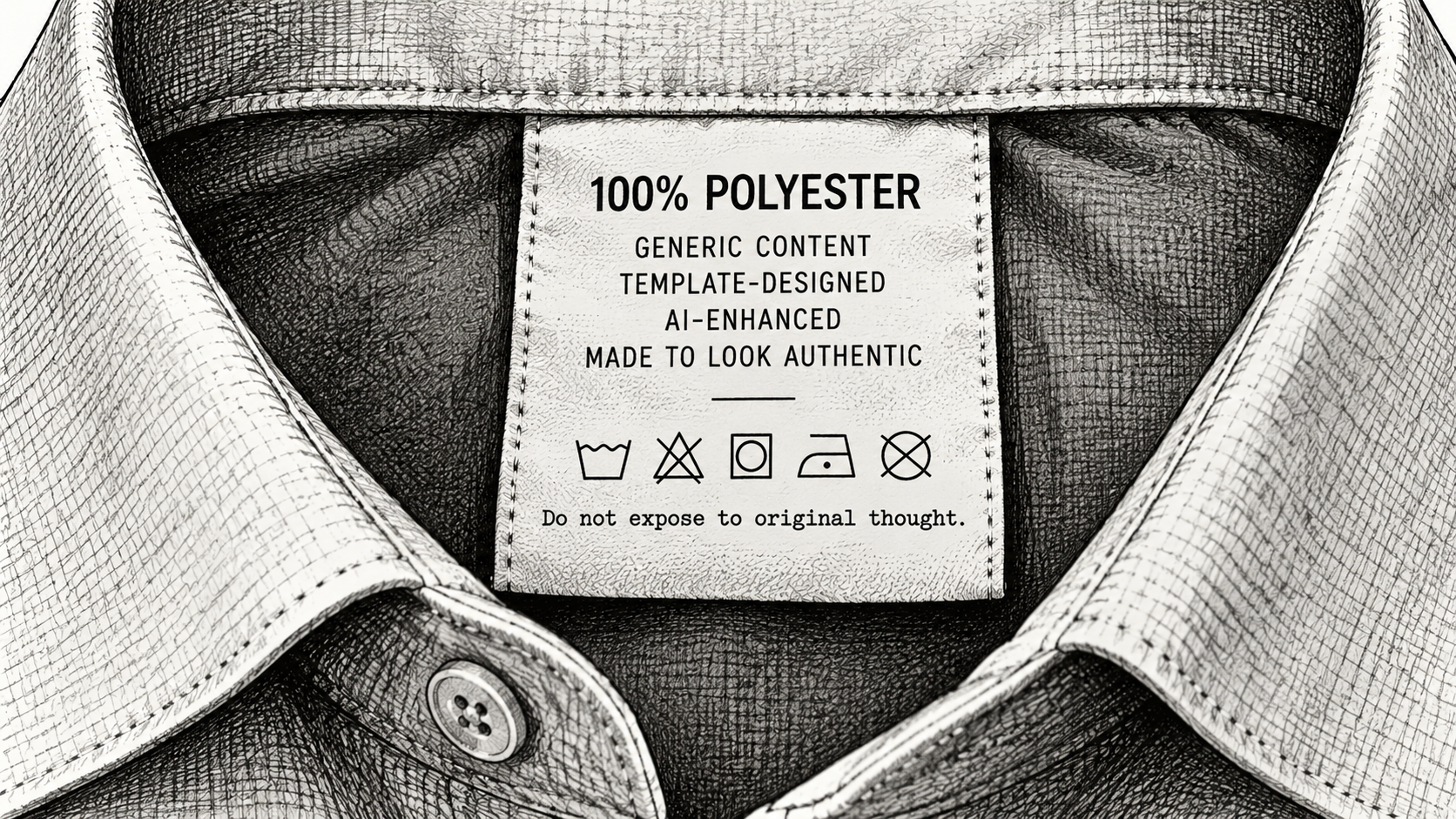
Gen Alpha has a new insult: polyester.
Yes, the fabric. But online, “polyester” has become a way of describing something that feels cheap, artificial, mass-produced, or desperately engineered to look better than it really is. It began as a criticism of a certain kind of overwrought social media edit and quickly escaped into the broader culture. Now an aesthetic can be polyester. A lifestyle can be polyester. A person can apparently be polyester.
Naturally, a brand can be polyester, too.
And while the slang itself may disappear by the time half the Fortune 500 figures out what it means, the criticism behind it is worth paying attention to. Polyester is what happens when the effort to manufacture an impression becomes more visible than whatever was supposed to create that impression in the first place.
Marketing produces an awful lot of it.
We have become extraordinarily good at making things look like brands. We have sophisticated design systems, powerful research tools, beautiful photography, endless amounts of data, and increasingly sophisticated technology capable of generating content almost instantly. Yet wander through enough websites, advertising, social feeds, or corporate communications, and you begin to encounter a strange sameness. Everyone is innovative. Everyone is authentic. Everyone has a purpose. Everyone is building community, creating meaningful experiences, and changing the world.
None of those things is necessarily untrue. They have simply been repeated so often that they tell us almost nothing.
That’s the polyester problem. The material can look terrific from across the room. Get close enough, though, and you realize you’ve seen it before.
For years, marketers have responded to this problem by pursuing “authenticity,” which has created the wonderfully absurd spectacle of organizations carefully manufacturing ways to appear less manufactured. We traded studio photography for smartphone video, polished executives for executives in hoodies, scripts for carefully rehearsed spontaneity, and corporate language for brands that suddenly started talking like your mildly annoying friend on TikTok.
The problem is that authenticity isn’t an aesthetic. You cannot art-direct your way into having a personality.
A brand becomes interesting when there is something particular underneath it: a history, an obsession, a way of doing things, a point of view, an imperfection, a constituency, or even a contradiction. Those are the things competitors cannot easily reproduce because they aren’t marketing devices. They’re actually yours.
The temptation, of course, is to borrow somebody else’s.
Brands have always done this. One company succeeds by being irreverent, and suddenly an entire category discovers sarcasm. Another builds a following around a social position, and corporate purpose statements multiply like rabbits. A visual style takes off, and six months later everyone seems to have hired the same designer.
Or, increasingly, nobody hired a designer at all.
Scroll through social media right now, and you can practically see the Canva templates multiplying. There is the inspirational quote in the tasteful font, the statistic rendered enormous against a geometric background, the carousel with the oversized headline and little swipe arrow, and the obligatory stock photo peeking out from behind a rounded rectangle. Change the logo, swap the brand colors, and congratulations: content.
Canva isn’t the problem. It democratized design and gave people an extraordinarily useful tool. The problem is what happens when access to a design tool gets confused with having an idea. A template can solve the mechanics of putting something on the screen, but it cannot tell you whether the thing deserved to be there in the first place.
The result is a social landscape filled with graphics that are exhaustingly obvious. You recognize the format before you absorb the message, which is almost the opposite of what good creative work is supposed to accomplish. Instead of making a brand more recognizable, all that frictionless design can make the source nearly irrelevant. It could be a bank, a university, a dentist, a nonprofit, or the motivational LinkedIn account of someone you vaguely remember meeting at a conference.
That’s polyester.
Trends aren’t inherently bad, and neither is learning from competitors. The trouble begins when we confuse the things a successful brand does with the reason people care about it.
That distinction is about to become much more important because generative AI has made polyester astonishingly cheap to manufacture.
AI can produce a hundred headlines, a month’s worth of social content, a dozen campaign concepts, and a thought-leadership article about the transformative power of human-centered innovation before you’ve finished your coffee. Used well, that’s enormously valuable. Used without a strong underlying identity, it allows organizations to produce generic marketing at a speed and scale previously unimaginable.
This is one of the more interesting paradoxes of AI: as producing competent content becomes easier, having something distinctive to say becomes more valuable.
The scarce resource isn’t content anymore. It’s specificity.
What do you believe that your competitors don’t? What do your customers experience that they couldn’t get somewhere else? What do you do in a way that is unmistakably yours? What are you willing to say that others wouldn’t? Just as importantly, what are you willing not to say simply because everyone else is saying it?
Those aren’t creative questions. They’re strategic ones.
Which is why the polyester test might actually be useful long after the insult has vanished from Gen Alpha’s vocabulary.
The next time you’re reviewing a campaign, a website, a piece of content, or a brand refresh, forget for a moment whether it’s polished, contemporary, optimized, or on trend. Ask something simpler:
Could this have come from almost anyone?
If the answer is yes, don’t spend more money polishing it.
Figure out what is actually yours.
Nobody wants to be polyester.