
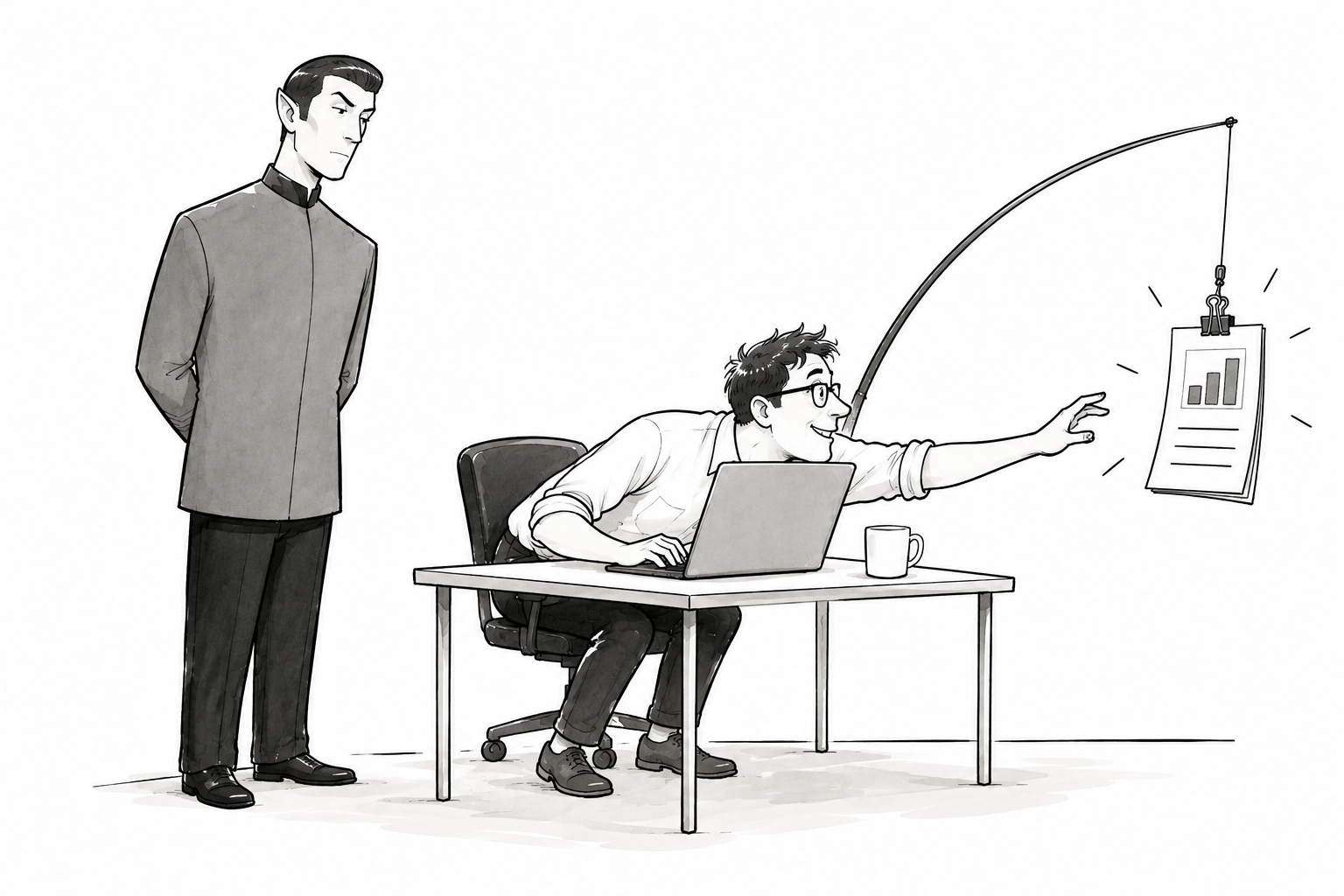
Your marketing (probably) doesn’t have an attention problem. But marketing is obsessed with attention. We want to stop the scroll, break through the clutter, grab eyeballs, and hook people in the first three seconds. When something underperforms, we often diagnose the problem the same way: people aren’t paying attention.
But what if attention isn’t the problem?
That question occurred to me while reading psychiatrist Awais Aftab’s recent New York Times essay, “What If A.D.H.D. Isn’t About Attention at All?” (Sept. 29, 2026). Aftab examines research challenging the familiar understanding of attention deficit hyperactivity disorder and introduces an important distinction between attention and what he calls “sustained engagement.”
His argument is about psychiatry, not marketing, but the distinction is useful for a field that has built an entire vocabulary around capturing attention. As Aftab explains it, attention in the scientific sense is about selecting relevant information in a particular moment. Sustained engagement is about keeping that attention directed at the same thing over time.
Marketing has gotten very good at the first part. We aren’t always as good at recognizing the second.
We know how to make people look
Open almost any social platform, and you’ll encounter an enormous machine devoted to capturing attention. Start with a surprising statement. Put text over the video. Change the camera angle. Use a provocative thumbnail. Ask a question. Create a curiosity gap. Make it shorter, louder, or stranger.
Much of it works. A bizarre video can stop someone mid-scroll, a cryptic headline can earn a click, and an unexpected image can make someone stare for several seconds while trying to determine what they’re seeing.
But all we’ve established is that someone looked.
Looking isn’t necessarily evidence that someone cares, and getting someone to notice something isn’t the same as giving them a reason to continue. Marketers routinely use “attention” to describe several different behaviors as though they were evidence of the same thing.
A better progression might be notice → interest → sustained engagement.
Something enters our awareness, we evaluate whether it has value, and then we decide whether to keep going.
Except marketers have become very good at inserting a conversion between those steps and calling it success.
The folder full of things I’ll never read
Consider one of the oldest tactics in the marketing playbook: gate the information. Promise a report, case study, white paper, or research brief, but make people hand over their contact information before they can have it.
I’m as guilty as anyone of making that trade. Something catches my attention, the premise sounds interesting enough, and suddenly I’ve surrendered my name, email address, employer, and job title for the privilege of downloading a PDF.
By conventional measures, that worked. I clicked, filled out the form, and downloaded the file. The marketing team got a lead, and somewhere, a dashboard registered a conversion.
There’s also a folder on my laptop containing gigs of reports, case studies, and white papers I’ve downloaded and will almost certainly never read.
My willingness to exchange information for the idea of reading something is not evidence that I engaged with it. The marketing got me through the gate, but not necessarily through the document. Yet the measurable event happened at the gate, so that’s where we tend to declare victory.
The click tells us the promise was compelling. The form fill tells us the anticipated value was high enough to tolerate some friction. Neither tells us whether the thing on the other side sustained engagement.
We may be optimizing the transaction we can measure rather than the experience we wanted to create.
Attention gets you the moment. Worth gets you the next one.
One of the more interesting ideas in Aftab’s essay concerns salience: whether something registers as significant or worth doing. He describes research suggesting that some behaviors commonly understood as problems of attention may instead involve motivation, reward, and the perceived significance of an activity.
Consumer behavior isn’t a clinical condition, and this isn’t an argument that the neurological mechanisms involved in A.D.H.D. explain marketing engagement. The useful connection is conceptual. Once we separate noticing something from deciding that it is worth continuing, familiar marketing behavior starts looking different.
Worth doesn’t necessarily mean useful. Entertainment, curiosity, recognition, beauty, surprise, discovery, and feeling understood can all make an experience worth continuing. Even confusion can have worth.
Ambiguous content demonstrates this particularly well. Show someone something they can’t immediately explain, and the uncertainty itself can command attention. We want resolution: What am I looking at? What does this mean? What’s going to happen?
That uncertainty can buy another second, but another second isn’t the same thing as another minute. If resolving the ambiguity produces nothing interesting, the audience has no reason to stay.
The hook worked, but the content didn’t.
We’ve optimized the entrance
We’re constantly told that audiences have microscopic attention spans, yet those same people watch three-hour podcasts, disappear into Reddit threads, binge television series, and watch someone restore a rusted tool for 25 minutes.
People haven’t lost the capacity to stay engaged. They’re selective about what earns that engagement.
The familiar complaint that “people don’t pay attention anymore” may conceal a less comfortable possibility: people aren’t unwilling to give us their attention. They’re unwilling to keep giving it to things that don’t reward them for doing so.
That’s a different marketing problem. Making the thumbnail brighter isn’t going to fix it.
It also changes how we should think about that folder on my laptop. Those marketers successfully created enough anticipated value for me to act. But the action they measured occurred before the harder test began: whether the experience justified the promise that got me there.
The attention economy may be optimizing the wrong moment
None of this makes attention unimportant. Without attention, engagement never begins. But attention is the entrance to an experience, not evidence that the experience itself is working.
A view tells us someone encountered something. A click tells us someone wanted to see what was on the other side. A form submission tells us the anticipated value was sufficient for someone to give something up to get it. Those are useful signals, but they don’t tell us what happened next.
Maybe that’s where we should spend more time looking. Once curiosity has been created, does it deepen? Does the audience discover something worth knowing? Did the report get read rather than merely downloaded? Does the experience provide enough value to justify continuing?
Marketing has spent years asking how to get people’s attention. Aftab’s distinction suggests that attention may only describe the beginning of what we’re actually trying to accomplish.
The more useful question may be: Once we have their attention, why should they stay?
Source: Awais Aftab, “What If A.D.H.D. Isn’t About Attention at All?,” The New York Times, Sept. 29, 2026.