
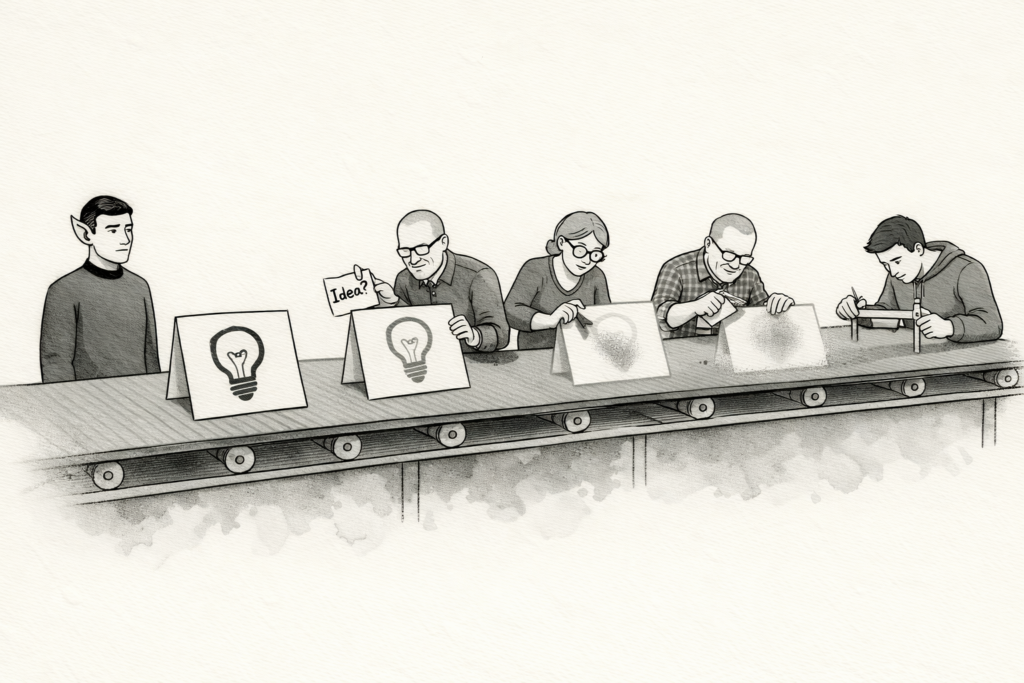
The first version of the idea didn’t need much defending. It was grounded in something real—enrollment pressure that wasn’t going away, a perception gap that showed up in the data, a clear mismatch between how the institution saw itself and how it was actually experienced. You didn’t have to sell it. You just had to point to it.
In the first conversation, it held its shape. People asked questions, but they were the kind that sharpen things rather than slow them down. There was a sense, however brief, that something might actually move.
Then it entered the system.
Not all at once. It never does. It moved the way things move in higher ed—through additional conversations, expanded groups, well-intentioned attempts to make sure the right voices were included. Someone wanted to revisit the language. Someone else wanted to make sure it fully reflected the institution. Another wanted to pressure test how it might land.
None of it was unreasonable on its own.
That’s the problem.
Because nothing in that process actually stops the work. It doesn’t get rejected. It gets handled. Adjusted. Interpreted. Improved. Aligned.
And over time, that handling changes it.
By the time the idea comes out the other side, it’s still there, but it’s not the same. The tension that made it useful has been smoothed out. The edges that made it distinct have been softened. It’s easier to agree with, easier to move forward, and far less likely to do what it was originally meant to do.
This isn’t about people missing the point. It’s about what the system does to the work.
Higher education is built to distribute authority and invite input. It’s designed to reduce risk by widening the conversation and to share accountability across groups rather than concentrate it in one place. Those are not flaws. They’re intentional.
But they create a consistent outcome. Ideas are reshaped until they are safe.
Marketing feels this faster than most. Strategy becomes visible early, which means it becomes available for interpretation early. The circle expands, and with it, the number of perspectives shaping the work. What started as a response to an external problem gradually becomes something that reflects internal comfort.
Over time, you see it in the output. Positioning that feels familiar. Messaging that avoids saying anything that might create friction. Campaigns that are well considered and largely interchangeable.
Nothing is obviously wrong.
But very little is effective.
And that has consequences. It becomes harder to shift perception, harder to respond when competitors move, harder to build any kind of momentum that carries from one cycle to the next. Especially in environments where marketing is expected to contribute but not empowered to decide.
The instinct is to lean further into the process. To bring more people in, gather more input, refine the work until it feels fully aligned.
But that’s usually what got you there.
The alternative isn’t less collaboration. It’s a different relationship to time and to the work itself.
The most effective marketing doesn’t wait to be fully agreed upon before it moves. It puts something into the world and lets reality respond. Sometimes it works. When it does, you build on it. Sometimes it doesn’t. When it doesn’t, you adjust and go again.
That cycle—move, learn, refine—is where clarity actually comes from.
Because once something exists, it’s harder to quietly reshape. It creates feedback that isn’t theoretical. It forces a different kind of conversation.
Over time, the role of strategy shifts. Instead of trying to preserve an idea in its original form, the focus becomes building something that can move through the system without losing its function. Something grounded enough to hold its shape, but flexible enough to survive interpretation.
Not perfect.
But durable.
This is where Brand Socket operates.
Not outside these dynamics, but inside them.
The work isn’t just about developing strategy. It’s about building strategy that can survive the way decisions actually get made. That starts by grounding the work in external signals—student behavior, market dynamics, and outcomes—so the conversation doesn’t drift back to internal preference.
It also means clarifying decision paths early. Not in theory, but in practice. Who decides, when the work moves, and what “good” looks like before the process expands.
From there, the focus shifts to durability. Strategy is designed to hold its shape even as it moves through multiple layers of input. Clear enough to stay intact. Flexible enough to be interpreted without losing function.
And just as important, the work moves. Not after endless discussion, but early enough to generate real-world response. Because once something is live—once it’s visible, experienced, and producing signal—it becomes much harder to quietly reshape into something else.
The goal isn’t to fight the system.
It’s to build work that moves through it—and still works on the other side.
Higher education doesn’t fail to change. It processes change until it’s safe.
The question isn’t whether that dynamic exists. It’s whether the work is built to move through it, or whether it gets reshaped by it along the way.
If this feels familiar, it usually is.
And if you’re trying to move something forward without watching it get softened into irrelevance, Brand Socket is designed for exactly that problem.
Not just to develop the idea.
But to make sure it actually lands.