
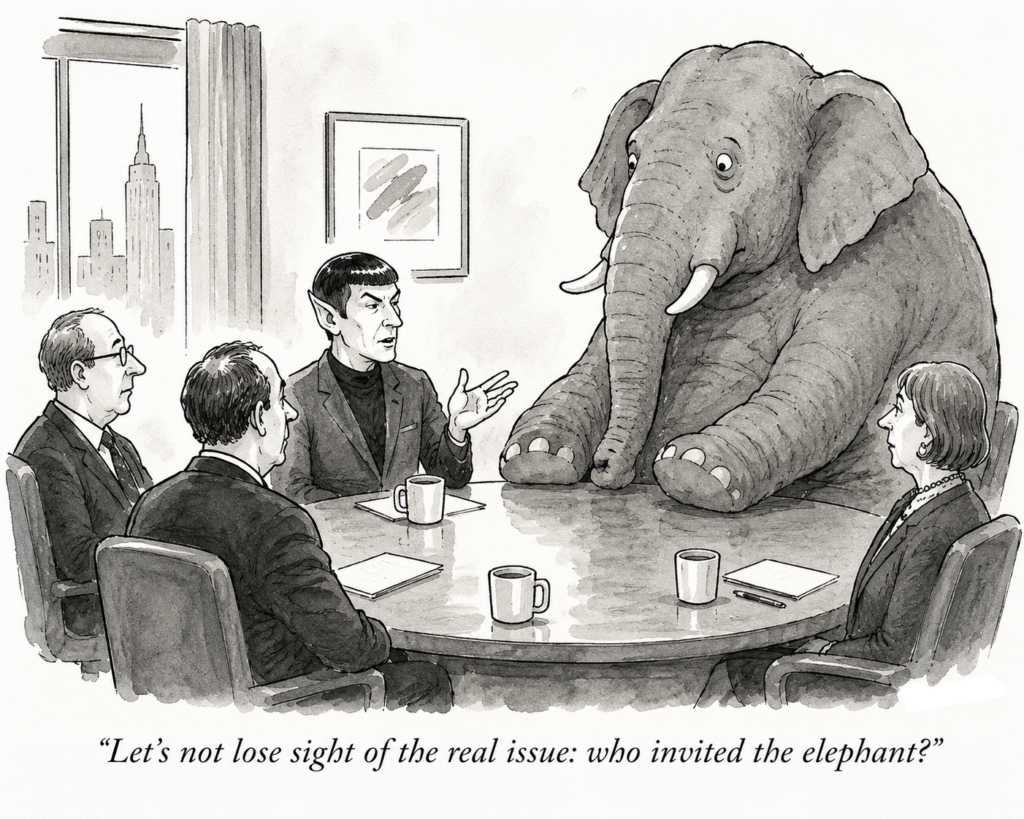
One of the most persistent myths in organizational life is that resistance to change is primarily about fear.
Sometimes it is.
More often, it is about something else entirely.
It is about what leaders choose to protect.
People inside organizations are rarely pursuing the same outcome. They may share a mission statement, strategic plan, or set of institutional values, but they often differ in what they believe deserves preservation.
Some leaders are oriented toward possibility. They look at an organization and see unrealized potential. They ask what could be built, improved, or transformed. They focus on capability, culture, talent, and future performance.
Others are oriented toward continuity. They focus on stability, consistency, institutional memory, and preserving what already exists. They ask what might be disrupted, displaced, or altered if significant change occurs.
Neither perspective is inherently right or wrong.
In healthy organizations, both are necessary.
The challenge arises when stewardship shifts from protecting institutional strengths to protecting institutional comfort.
At that point, stewardship can quietly become protectionism.
The most important organizational conflicts are rarely disagreements about mission. More often, they are disagreements about whether existing assumptions still deserve protection.
The builder asks:
“What could this become?”
The steward asks:
“What should be preserved?”
Both are valuable questions.
The more important question, however, may be:
“Is what we are preserving still worthy of preservation?”
That question is surprisingly difficult for organizations to answer.
Over time, processes become traditions. Traditions become expectations. Expectations become assumptions. Eventually, assumptions become so embedded in the culture that they are rarely examined at all.
This creates continuity bias: the tendency to favor existing structures, processes, and practices simply because they already exist.
The bias is understandable. Familiar systems feel safer than unfamiliar ones. Existing relationships feel more reliable than new approaches. Longstanding practices carry the comfort of institutional memory.
The problem is that familiarity and effectiveness are not the same thing.
An organization can become highly skilled at preserving systems that no longer serve its mission.
In fact, many institutions devote considerable energy to protecting processes without periodically reassessing the problems those processes were originally designed to solve.
The result is a subtle but important shift.
Leaders begin defending the mechanism rather than the outcome.
The conversation moves from:
“Is this helping us achieve our mission?”
to:
“Why would we change this?”
The distinction matters.
One question is mission-oriented.
The other is familiarity-oriented.
This is often where builders and stewards begin talking past one another.
The builder sees:
- unrealized potential
- opportunity
- capability development
- adaptation
- future performance
The steward sees:
- continuity
- consistency
- institutional memory
- established relationships
- organizational equilibrium
Neither side is necessarily acting in bad faith.
But every leadership orientation has a shadow side.
The shadow side of transformational leadership is well understood:
- initiative overload
- burnout
- constant disruption
- underestimating implementation complexity
- mistaking activity for progress
The shadow side of stewardship receives far less attention:
- organizational inertia
- accountability avoidance
- protection of ineffective systems
- preference for comfort over effectiveness
- rewarding compliance over initiative
- elevating harmony above honest conversation
This matters because toxic cultures are rarely created intentionally.
In fact, many toxic cultures emerge from behaviors that initially appear virtuous.
A leader avoids confronting poor performance in order to preserve collegiality.
A leader suppresses dissent in order to preserve harmony.
A leader resists new approaches in order to preserve stability.
A leader protects underperforming structures in order to preserve institutional knowledge.
The intent sounds noble.
The outcome often is not.
Over time, the organization learns powerful lessons:
- difficult conversations are unwelcome
- challenging assumptions is risky
- raising concerns carries consequences
- preserving relationships matters more than solving problems
- comfort is rewarded more consistently than candor
What emerges is not stability.
It is stagnation.
Not stewardship.
Protectionism.
The mission gradually becomes secondary to maintaining equilibrium.
This is why the most important leadership question is not whether change should occur.
Nor is it whether traditions deserve respect.
The real question is whether the institution is protecting strengths or protecting assumptions.
Those are not the same thing.
Every organization carries legacy assumptions: beliefs about students, employees, customers, processes, and success that were once useful. Effective stewardship requires periodically examining whether those assumptions still reflect current reality.
Without that examination, stewardship can become an end unto itself.
The institution becomes extraordinarily effective at preserving yesterday’s solutions while becoming increasingly incapable of addressing today’s challenges.
The healthiest organizations understand that continuity and transformation are not opposing forces.
Builders ensure the institution does not become trapped by its past.
Stewards ensure the institution does not abandon what makes it valuable.
Both are essential.
The danger emerges when either side gains too much influence.
An organization without stewards becomes unstable.
An organization without builders becomes stagnant.
But an organization that confuses preservation with purpose risks something even worse: a culture where protecting the familiar becomes more important than fulfilling the mission.
And when that happens, stewardship stops being a leadership virtue and becomes a source of organizational decline.